
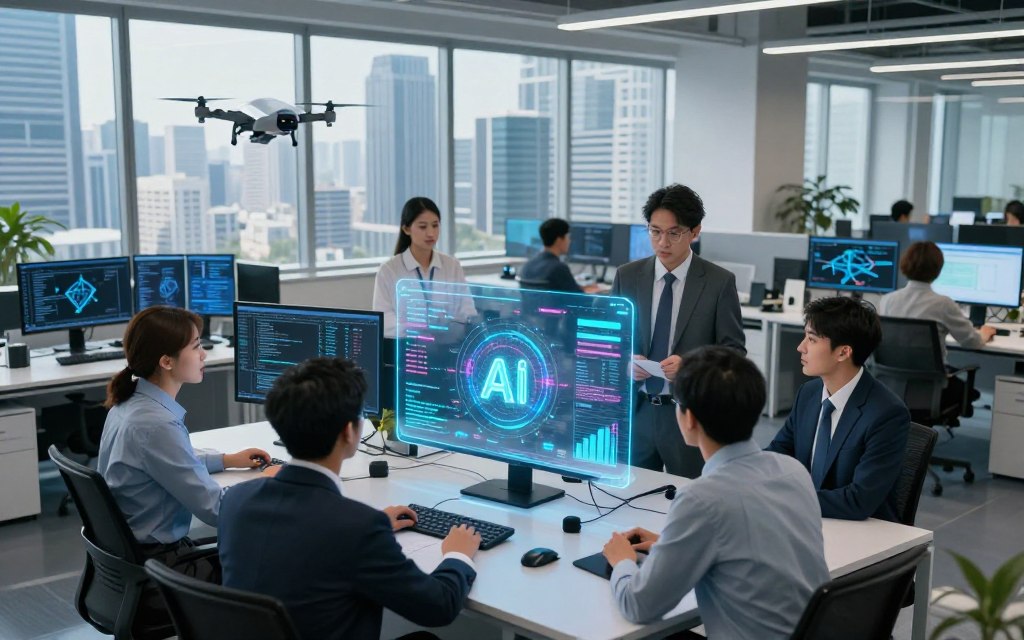
What is new technology in IT industry? Today’s IT technology trends bring together several innovations. Emerging capabilities—generative AI, cloud-native infrastructures, and edge computing—work together to improve productivity and cybersecurity.
As organizations improve customer experiences and streamline operations, they assess emerging technology by its business value, risk, and long-term scalability. This approach helps decision-makers choose solutions that support strategic goals instead of simply following the latest trends.
This article explores technology innovation and key changes shaping the IT sector today. It examines how quantum research, zero trust security, extended reality, automation, and sustainable computing are changing business operations. Understanding these trends helps leaders manage modern technology’s complexity and make informed organizational decisions.
Key Takeaways
- Generative AI and cloud-native infrastructures are driving significant change.
- Organizations must evaluate innovations based on business value and risk.
- Interconnected capabilities influence productivity and cybersecurity.
- Extended reality and automation are reshaping customer experiences.
- Sustainable computing is becoming a priority for modern businesses.
1. The Rise of Generative AI and Large Language Models
Generative AI in business and large language models (LLMs) are changing the IT landscape. These technologies help businesses automate processes, improve decisions, and strengthen customer interactions. As organizations move from basic chatbots to advanced applications, understanding foundation models becomes essential.
Foundation Models and Enterprise Adoption
Foundation models power generative AI applications. They are trained on huge datasets, so they can understand and create human-like text. Enterprises increasingly use these models for many tasks, including:
- Customer Service: Automating responses to common inquiries.
- Software Development: Assisting developers with code suggestions.
- Marketing: Creating personalized content for campaigns.
- Legal Research: Streamlining document review processes.
- Healthcare Administration: Managing patient data efficiently.
This shift shows why enterprise AI adoption is growing: organizations see clear benefits from these technologies.
Practical Applications Across US Industries
Generative AI is more than a trend; it supports practical work across several US industries. Here are notable examples:
- Financial Analysis: Automating data analysis to improve investment decisions.
- Manufacturing Documentation: Generating reports and manuals automatically.
- Employee Support: Providing instant assistance to staff queries.
These examples show how generative AI can raise productivity and efficiency across many sectors.
Governance, Risk, and Ethical Considerations
As organizations use generative AI, they must address governance and ethical concerns. Key issues include:
Related Posts:
- How Technology Is Changing Student Learning:…

- What Is LoT in Technology The Language of Things Concept

- How Technology Has Changed Consumer Behavior The…

- Is a Laptop a Technology Understanding Personal Computing

- How Can Technology Be Improved Addressing…

- What Is Life Technology Exploring Biotech and Life Sciences

- Accuracy Limitations: Understanding the potential for errors and “hallucinations” in AI-generated content.
- Intellectual Property: Navigating ownership rights of AI-generated outputs.
- Privacy: Ensuring data protection and compliance with regulations.
- Bias: Identifying and mitigating biases in AI models.
- Model Security: Protecting against unauthorized access and misuse.
Strong AI governance helps organizations gain value while reducing operational and regulatory risks. It should include access controls, data-quality programs, and thorough employee training.
2. Edge Computing and Distributed Architectures
Edge computing is changing how industries process and use data. By moving storage and processing near the data source, businesses cut delays and support real-time decisions. This change matters where each millisecond counts, including manufacturing and healthcare.
In a distributed IT architecture, edge computing handles data efficiently and reduces reliance on central data centers. It also saves bandwidth and strengthens systems against connection problems. Organizations can use their data more fully as they adopt this technology.
Latency Reduction and Real-Time Processing
Edge computing can greatly reduce latency. When processing happens near the source, organizations can achieve real-time data processing. This benefit supports applications such as:
- Predictive maintenance: By analyzing machine data on-site, companies can foresee equipment failures before they occur.
- Machine vision: In manufacturing, real-time image processing can enhance quality control and reduce errors.
- Robotics: Autonomous robots can make instant decisions based on local data, improving operational efficiency.
Integration with 5G Networks
The rise of 5G networks supports 5G edge computing. Faster connections and improved network slicing let more devices connect smoothly.
However, 5G supplies infrastructure but does not create an edge architecture automatically. Organizations must plan edge solutions to gain the most from 5G.
Use Cases in Manufacturing and Healthcare
Edge computing use cases are growing quickly, especially in manufacturing and healthcare. In manufacturing, companies use edge solutions for:
- Remote monitoring: Keeping track of equipment health without needing to be on-site.
- Connected medical equipment: Devices that can transmit data in real-time for immediate analysis.
- Imaging workflows: Faster processing of imaging data can enhance patient care.
Despite its benefits, edge computing brings challenges. Teams must address device management, physical security, uneven connectivity, and data synchronization. They should also prioritize centralized observability to control distributed environments.
3. Quantum Computing Breakthroughs
Quantum computing is advancing quickly and may reshape technology’s future. IBM, Google, and Microsoft lead work on hardware, error correction, and quantum algorithms. These advances support practical quantum systems.
Progress from IBM, Google, and Microsoft
IBM, Google, and Microsoft lead quantum computing breakthroughs. IBM’s Quantum Experience lets users test quantum algorithms on real quantum hardware. Google’s Sycamore processor achieved quantum supremacy in specific tasks, while Microsoft builds an ecosystem focused on developer access and cloud integration.
Quantum-as-a-Service Offerings
Quantum-as-a-service helps businesses and researchers use quantum computing through the cloud. It removes the need for specialized hardware and supports work in materials science, optimization, and drug discovery. Organizations can innovate without the large investment often required by quantum technologies.
Implications for Cryptography and Data Security
Quantum computing raises major questions about quantum cryptography and data security. Quantum computers may break traditional encryption, raising fears of a “harvest now, decrypt later” strategy. Organizations must inventory their cryptographic dependencies and track developments in post-quantum security standards.
Preparing for practical quantum-capable threats is essential to protect sensitive information.
“Quantum computing has the potential to solve problems that are currently beyond the reach of classical computers.”
As we move forward, businesses need migration plans to keep data secure in the quantum era. For further insights on improving technology, check out this article on addressing limitations and ethics in technology.
4. Zero Trust Security Frameworks
Today’s digital landscape makes zero trust security a vital cybersecurity framework for many organizations. This approach addresses cloud services, remote work, and third-party access. Unlike traditional models, zero trust requires continuous verification for users and devices inside corporate networks.
The core principle is simple: never trust, always verify. Every user, device, application, and access request needs authentication and authorization before reaching sensitive resources. Organizations can implement this framework through various strategies, including:
- Multifactor Authentication: Requiring multiple forms of verification to enhance security.
- Least-Privilege Access: Ensuring users have only the access necessary for their roles.
- Device Posture Checks: Verifying that devices meet security standards before granting access.
- Network Segmentation: Dividing networks into smaller, isolated segments to limit access.
- Application Controls: Monitoring and controlling application access based on user roles.
- Encryption: Protecting data both in transit and at rest to prevent unauthorized access.
- Continuous Monitoring: Regularly assessing user behavior and access patterns for anomalies.
- Incident Response: Having a robust plan in place to address security breaches swiftly.
Identity-Centric Security Models
Identity-centric security is a key part of the zero trust framework. This model connects workforce identities, machine identities, service accounts, and privileged users. Focusing on identity helps organizations manage access to sensitive information and systems.
Centralized identity and access management (IAM) solutions help enforce security policies. They ensure that only authorized users can access critical resources. Privileged access management (PAM) tools control access to sensitive data and systems, reducing insider threat risks.
Security information and event management (SIEM) systems support identity-centric security through real-time event monitoring and analysis. Endpoint detection and response (EDR) solutions help identify and reduce threats on connected devices.
Regulatory Drivers in the United States
In the United States, regulations and contracts drive zero trust security adoption. Federal guidance from NIST and CISA stresses strong security measures. Sector requirements and breach reporting expectations also push organizations toward these frameworks.
Customer security assessments are becoming more common. Organizations must show their commitment to protecting sensitive data. Following these rules strengthens cybersecurity and builds client trust.
As organizations face modern threats, zero trust architecture helps protect sensitive information and support compliance with US cybersecurity regulations. To learn more about zero trust principles, explore resources from IBM.
5. Cloud-Native Development and Platform Engineering
Cloud-native development is changing how enterprises deliver software and manage operations. It uses containers, orchestration, automation, APIs, and observability to build infrastructure that can scale. These tools help teams deliver faster and adapt to changing market demands.
The growth of Kubernetes and microservices has driven this change. Kubernetes, an open-source container orchestration platform, helps developers manage applications efficiently. Microservices support modular deployment, which makes updates and scaling easier, but teams must watch for complex services and distributed failures.
5.1 Kubernetes and Microservices Evolution
Kubernetes and microservices now anchor cloud-native development. Kubernetes provides a strong framework for managing containerized applications. It automates deployment, scaling, and operations, while microservices split applications into independent services that teams can develop and deploy separately.
5.2 Internal Developer Platforms
As organizations adopt cloud-native practices, the concept of internal developer platforms offers a vital response. These platforms provide reusable tools, workflows, templates, and guardrails for development teams. They standardize infrastructure provisioning, security controls, and deployment pipelines, supporting platform engineering while empowering developers and promoting compliance and security.
5.3 Hybrid and Multi-Cloud Strategies
Many businesses use hybrid cloud strategies to gain public and private cloud benefits, including resilience, data residency, and specialized services. This hybrid cloud strategy can also support multi-cloud plans, which control costs and connect systems after a merger. Success requires architecture governance, skills development, and cost visibility.
“The future of cloud-native development lies in the ability to adapt and innovate continuously.”
| Aspect | Cloud-Native Development | Traditional Development |
|---|---|---|
| Flexibility | High | Low |
| Scalability | Dynamic | Static |
| Deployment Speed | Rapid | Slow |
| Complexity | Moderate | High |
In conclusion, cloud-native development and platform engineering are essential for modern enterprises. By using Kubernetes, microservices, and an internal developer platform, organizations can improve operations and stay competitive as technology changes.
6. Extended Reality (XR) for Enterprise Applications
Extended reality (XR) combines augmented reality (AR), virtual reality (VR), and mixed reality (MR) for business. These immersive technology tools improve user experiences, efficiency, and innovation across many industries.
Devices like the Microsoft HoloLens and Meta Quest for business lead enterprise XR. They blend digital content with real-world settings to improve training, design, and collaboration.
Microsoft HoloLens and Meta Quest Deployments
The Microsoft HoloLens creates a mixed reality experience with holograms in physical spaces. It helps healthcare and manufacturing teams deliver hands-on training and view real-time data visualization.
By contrast, the Meta Quest for business provides fully immersive spaces for simulations and remote meetings. Each device has strengths, so businesses must match their choice to specific needs.
Training, Design, and Remote Collaboration
XR tools help with employee training and product design. Companies can run safety simulations, letting workers practice in a risk-free environment. For product design, teams can manipulate 3D models, speeding iterations and encouraging creativity.
XR also changes remote collaboration. Teams in different locations can work in shared virtual spaces, reducing travel costs and improving communication. This matters in today’s increasingly remote work culture.
ROI Considerations for US Enterprises
When adopting XR technologies, enterprises should measure their potential return on investment (ROI). They should track these key results:
- Reduced training time
- Lower travel expenses
- Faster design reviews
- Improved knowledge transfer
- Reduced equipment downtime
To improve ROI, businesses should define a workflow and measurable baseline before buying hardware. This approach aligns XR projects with operational needs and supports clear results.
XR has great potential, but challenges remain. Headset comfort, battery life, and content development affect user adoption. Workplace safety, privacy, and cybersecurity also matter for successful implementation.
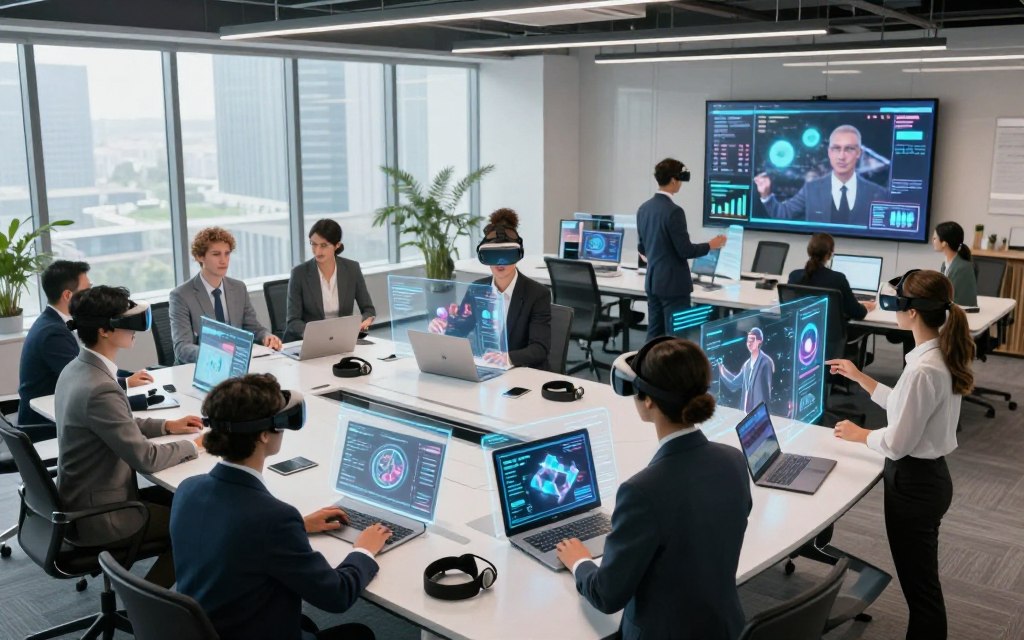
In conclusion, extended reality for business can transform enterprise operations. By using immersive technology, companies can improve training, streamline design, and strengthen collaboration. These gains can drive productivity and innovation.
For more insights on technology and its implications, visit this resource.
7. Sustainable IT and Green Computing Initiatives
Sustainable IT has grown from an environmental goal into a key business priority. Organizations now use green computing to improve efficiency and reduce their environmental footprint. This shift goes beyond compliance and supports a sustainable future for the industry.
Energy-efficient data centers are a key part of sustainable IT. They reduce energy use through better cooling, efficient server use, and innovative facility designs. These steps can lower energy costs, while renewable energy sources help reduce carbon emissions.
Energy-Efficient Data Centers
Energy-efficient data centers lead green computing initiatives. They use advanced technology and practices to manage power and distribute workloads efficiently. For instance, organizations can implement:
- Advanced cooling systems that use less energy
- Dynamic server utilization to reduce idle time
- Renewable energy procurement strategies
These methods lower operating costs and help organizations meet sustainability targets.
Carbon-Aware Cloud Computing
Carbon-aware cloud computing is an innovative approach that organizations are adopting. It schedules or locates workloads according to the carbon intensity of the energy grid. Choosing lower-emission times or locations cuts carbon footprints, rather than only reducing energy use.
ESG Reporting and Compliance
As businesses adopt sustainable IT, they must also focus on Environmental, Social, and Governance (ESG) reporting. Businesses use ESG technology for consistent measurement and transparent reporting of emissions across different scopes:
| Scope | Description | Examples |
|---|---|---|
| Scope 1 | Direct emissions from owned or controlled sources | Fuel combustion in company vehicles |
| Scope 2 | Indirect emissions from the generation of purchased electricity | Electricity used in data centers |
| Scope 3 | All other indirect emissions | Supply chain emissions, employee commuting |
Careful treatment of these emissions is essential for accurate ESG reporting. Organizations must make their data auditable and define boundaries clearly.
Sustainable IT practices benefit the environment and support business goals. By balancing sustainability targets with performance, security, and regulatory obligations, organizations can pave the way for a greener future.
8. Autonomous Systems and AI-Driven Automation
Technology is changing fast, especially through autonomous systems and AI-driven automation. These tools are reshaping industries and changing how businesses work. The shift from traditional robotic process automation (RPA) to intelligent automation could greatly improve efficiency and productivity.
Robotic process automation has changed greatly over the years. At first, RPA followed rules and handled repetitive tasks with little human help. Now, intelligent automation combines machine learning, natural language processing, and computer vision to manage complex workflows.
Robotic Process Automation Evolution
Today, RPA does more than perform simple tasks. It can learn, adapt, understand goals, plan tasks, and use software tools to find information. With defined controls, intelligent automation can complete multistep workflows while keeping processes efficient and secure.
AI Agents and Autonomous Workflows
AI agents lead this transformation. They can perform routine tasks alone, reducing human oversight and helping finance teams study large data sets for informed decisions. In customer operations, AI agents handle inquiries, and automation also affects procurement, human resources, IT service management, logistics, and claims processing.
Impact on the US Workforce
Automation can remove repetitive tasks, but it also redesigns roles and creates demand for new skills. The future of work in the United States will depend more on analytical, technical, interpersonal, and oversight skills.
Organizations must use workforce planning and reskilling initiatives to manage this change. Transparent communication about the role of automation helps maintain employee trust and service quality. By building a culture of change management, businesses can improve productivity while empowering their workforce.
“The key to successful automation lies not just in technology, but in how we manage the human element.”
9. Low-Code and No-Code Development Platforms
Low-code development and no-code platforms are changing how businesses create software. These tools help developers and business users build applications, workflows, dashboards, and integrations with little coding knowledge. This wider access improves agility and helps organizations meet their needs more efficiently.
A major benefit is the rise of citizen developers. Many have no formal programming background, yet they can contribute to software projects. They reduce backlogs, improve department productivity, and help organizations test ideas faster.
9.1 Democratizing Software Development
Low-code and no-code platforms make software development available to more people. This shift means that:
- Business users can create tailored solutions without needing extensive technical training.
- Organizations can respond to market changes more swiftly, enhancing competitiveness.
- IT departments can focus on more complex tasks, leaving routine applications to citizen developers.
9.2 Microsoft Power Platform and Salesforce Lightning
Two leading low-code platforms are the Microsoft Power Platform and Salesforce Lightning. They combine application development, workflow automation, data services, and analytics for comprehensive business solutions. Key features include:
- Microsoft Power Platform: Integrates seamlessly with Microsoft 365 and Azure, allowing users to create apps quickly.
- Salesforce Lightning: Offers robust tools for customer relationship management and process automation.
9.3 Limitations and Governance
Despite their advantages, low-code and no-code platforms have limitations. Organizations must consider potential issues such as:
- Platform lock-in, which can complicate migration to other systems.
- Licensing complexity that may lead to unexpected costs.
- Integration constraints that could hinder the functionality of applications.
- Performance issues if applications are not optimized.
- Inconsistent user experiences across different platforms.
- The risk of data duplication and unsupported departmental applications.
Effective governance helps reduce these risks. Organizations should implement:
- Approved connectors to ensure secure integrations.
- Identity controls to manage user access.
- Data-loss prevention policies to protect sensitive information.
- Regular code and configuration reviews to maintain quality.
- Documentation and monitoring to track application performance.
Low-code and no-code platforms reduce development effort, but they still need strong architecture, security, testing, and lifecycle management. Businesses must manage these challenges to gain the full value of these transformative technologies.
10. What Is New Technology in IT Industry: A Comprehensive Overview
To understand what is new technology in IT industry, look at how new tools work together. Generative AI, cloud-native platforms, and stronger cybersecurity create new business opportunities. This IT industry innovation is changing how organizations operate.
US technology investment trends show strong enterprise spending priorities. Companies are funding AI infrastructure, cloud modernization, and data platforms. They seek measurable business results, not just experiments, so investments deliver clear benefits.
Convergence of Multiple Innovation Streams
Several technology streams are joining to drive major change in the IT industry. For example, generative AI and edge computing can improve real-time data processing. Together, they help businesses use data better, improving decisions and daily efficiency.
Investment Trends in the US Market
Recent reports show that US enterprises are prioritizing these key investment areas:
| Investment Area | Focus | Projected Growth |
|---|---|---|
| AI Infrastructure | Enhancing data processing capabilities | 15% annually |
| Cybersecurity | Strengthening defenses against threats | 12% annually |
| Cloud Modernization | Transitioning to hybrid and multi-cloud solutions | 10% annually |
| Data Platforms | Improving data analytics and governance | 14% annually |
Skills and Talent Implications
This changing landscape creates new skills and talent challenges. Demand is growing for AI engineers, cloud architects, and cybersecurity professionals. Organizations need people who can navigate complex systems, support digital transformation, and close the IT skills gap.
Continuous learning and cross-functional teamwork are essential for success. Companies that develop workers and support innovation can use new technology more effectively.
11. Strategic Considerations for US Businesses
US businesses face unique challenges and opportunities in today’s changing technology landscape. To thrive, organizations need a comprehensive technology strategy aligned with business goals. This section covers readiness, maturity, an innovation roadmap, and choosing the right partners.
Assessing Readiness and Maturity
Before any technology initiative, conduct an IT readiness assessment. This review should cover several important areas, including:
- Business objectives
- Data quality and architecture
- Cybersecurity measures
- Talent availability
- Governance structures
- Integration capabilities
- Financial capacity
- Operational change readiness
Leaders can use these factors to measure their organization’s readiness for technology adoption. The results can identify initiatives that offer customer value, revenue potential, and compliance.
Building an Innovation Roadmap
An innovation roadmap turns technology trends into clear action. It should begin with:
- Defining a clear problem statement
- Establishing a baseline for current capabilities
- Selecting a controlled pilot project
- Setting success metrics
- Evaluating associated risks
- Creating a path to production
These steps give businesses a structured approach to innovation that supports their strategic goals.
Partner Ecosystems and Vendor Selection
Successful implementation depends on the right partners and careful technology vendor selection. When selecting vendors, consider:
| Criteria | Importance | Evaluation Method |
|---|---|---|
| Interoperability | High | Compatibility tests |
| Security | Critical | Third-party audits |
| Data Ownership | Medium | Contract review |
| Pricing Transparency | High | Cost analysis |
| Implementation Expertise | High | Reference checks |
These criteria help businesses choose vendors that support their long-term enterprise technology strategy.
Responsible technology adoption balances speed with disciplined governance. These steps can help US businesses succeed in a rapidly changing technology landscape.
12. Conclusion
The future of IT technology is bright and filled with opportunities. Emerging IT trends are reshaping how businesses operate and innovate. Companies are increasingly adopting technologies that drive business technology innovation.
The focus is on creating intelligent, automated, and secure digital environments.
Generative AI is leading the way by improving productivity and creativity. Edge computing enables faster data processing for real-time applications. Quantum computing is on the horizon, promising breakthroughs that will redefine data security and processing.
Zero trust security frameworks are becoming essential as organizations protect data. Cloud-native development supports IT modernization through flexibility and scalability, making market changes easier to manage. Extended reality transforms training and collaboration through immersive experiences that boost engagement.
As businesses explore autonomous systems and low-code platforms, they can streamline operations and empower employees. Successful adoption depends on choosing technologies that address real business challenges. Responsible governance and modern infrastructure will support sustainable growth.
Organizations that combine technological curiosity with strategic planning can navigate emerging IT trends. By validating performance and ensuring compliance, businesses can create measurable value and thrive in this dynamic environment.